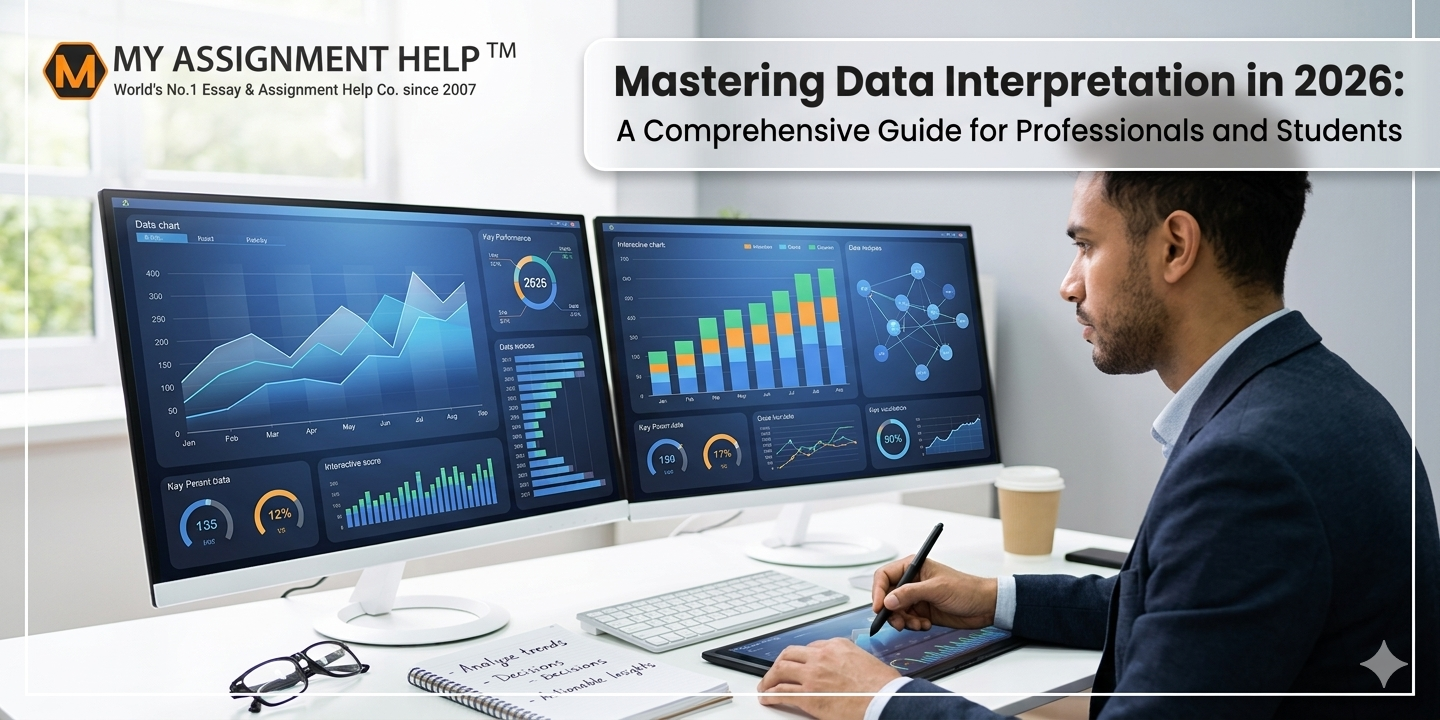
The digital landscape of 2026 is defined by an unprecedented deluge of information. With the global datasphere projected to exceed 175 zettabytes, the ability to simply collect data is no longer a competitive advantage. The true power lies in Data Interpretation—the process of reviewing data through some predefined processes which will help assign some meaning to the data and arrive at a relevant conclusion.
Whether you are an academic researcher, a business strategist, or a student navigating complex modules, mastering this skill is essential for evidence-based decision-making.
The Evolution of Data Interpretation in 2026
In recent years, the shift from descriptive analytics (what happened) to prescriptive analytics (how can we make it happen) has accelerated. Modern data interpretation now integrates AI-assisted synthesis with human-centric ethical oversight. According to a 2025 report by the UK Data Service, over 68% of UK enterprises now prioritize “Data Literacy” as the most sought-after soft skill in the recruitment process.
For students tackling advanced quantitative modules, the pressure to derive accurate insights from raw numbers can be overwhelming. Many scholars find that seeking statistics assignment help allows them to understand the underlying mathematical models—such as Bayesian inference or multivariate regression—before attempting to interpret high-level results in their dissertations.
Core Pillars of Effective Data Interpretation
To master data interpretation this year, one must move beyond basic spreadsheets and embrace a multi-dimensional approach:
1. Contextual Intelligence
Data does not exist in a vacuum. A 5% drop in conversion rates might look like a failure, but if the overall market trend dropped by 15%, that 5% actually represents a significant outperformance. Always define the ‘Why’ before the ‘What.’
See also: Latest News in Renewable Energy Technologies
2. Proficiency in Statistical Significance
Understanding the P-value and confidence intervals is non-negotiable. In 2026, we see a move away from “black box” AI interpretations toward “Explainable AI” (XAI). This requires the interpreter to verify if the patterns found are statistically sound or merely coincidental noise.
3. Visual Literacy
Modern interpretation relies heavily on dynamic visualization. Static bar charts have been replaced by interactive heat maps and Sankey diagrams. The goal of an infographic is to reduce cognitive load, allowing the brain to process complex relationships instantly.
Overcoming Common Pitfalls
Even the most seasoned analysts fall prey to cognitive biases. To ensure your interpretation follows E-E-A-T (Experience, Expertise, Authoritativeness, and Trustworthiness) standards, you must guard against:
- Confirmation Bias: Seeking out data that supports your existing hypothesis while ignoring contradictory evidence.
- Correlation vs. Causation: Just because two variables move together doesn’t mean one causes the other (e.g., ice cream sales and shark attacks both rise in summer, but they aren’t causal).
- Data Overfitting: Creating a model so complex that it describes the noise rather than the underlying trend.
For those balancing full-time work and higher education, the technical rigor of these analyses often leads to burnout. It is common for students to pay to do my assignment when they need professional-grade data modeling to serve as a benchmark for their own learning and interpretation efforts.
Step-by-Step Framework for Data Analysis (2026 Edition)
- Define the Objective: What specific question are you trying to answer?
- Data Cleaning (Wrangling): Remove duplicates and handle missing values. Reliability starts with clean data.
- Apply the Right Method: Choose between Qualitative (thematic analysis) or Quantitative (mean, standard deviation, frequency) methods.
- Visualize: Use tools like Tableau or PowerBI to spot outliers.
- Synthesize and Report: Turn the numbers into a narrative that stakeholders can act upon.
Key Takeaways
- Data Literacy is Mandatory: It is the “new reading” in the UK job market of 2026.
- Ethics First: Always consider data privacy and algorithmic bias during interpretation.
- Tool Integration: Mastery of Python, R, or advanced SQL remains the gold standard for technical interpretation.
- Human Element: AI provides the patterns, but humans provide the context and ethical judgment.
Frequently Asked Questions (FAQ)
Q1: What is the difference between data analysis and data interpretation? Data analysis is the process of ordering and structuring data, while data interpretation refers to the process of attaching meaning to the results and reaching a conclusion.
Q2: Which software is best for data interpretation in 2026? While Excel remains a staple, tools like Python (with Pandas and Scikit-learn), Tableau, and AI-integrated platforms like Microsoft Fabric are leading the industry.
Q3: How do I improve my data interpretation skills at home? Engage with open-source datasets (like Kaggle or the UK Government’s Data Portal), practice building dashboards, and study fundamental statistics.
Q4: Is AI replacing human data interpreters? No. AI is excellent at finding correlations, but it lacks the “Experience” and “Trustworthiness” (components of E-E-A-T) to understand cultural nuances and business ethics.
References & Sources
- Office for National Statistics (ONS), UK (2025): “The State of Data Literacy in British Higher Education.”
- University of Oxford: “Advanced Quantitative Research Methods in the 21st Century.”
- Harvard Business Review: “Why Explainable AI is the Future of Business Intelligence.”
About the Author: Dr. Alistair Vance
Dr. Alistair Vance is a Senior Academic Consultant and Content Strategist at MyAssignmentHelp. With over 12 years of experience in Applied Statistics and Data Science, Dr. Vance has helped thousands of UK students bridge the gap between theoretical mathematics and real-world data application. When not auditing SEO strategies or developing E-E-A-T compliant content, he contributes to various journals on the ethics of Machine Learning.